- Haresign Consulting
- 30 May, 2026
- Finance
- 14 min read
The Ready Reckoner Can Show Income. It Cannot Show the Fatigue
The Ready Reckoner Is Useful — But It Does Not Run Your Practice
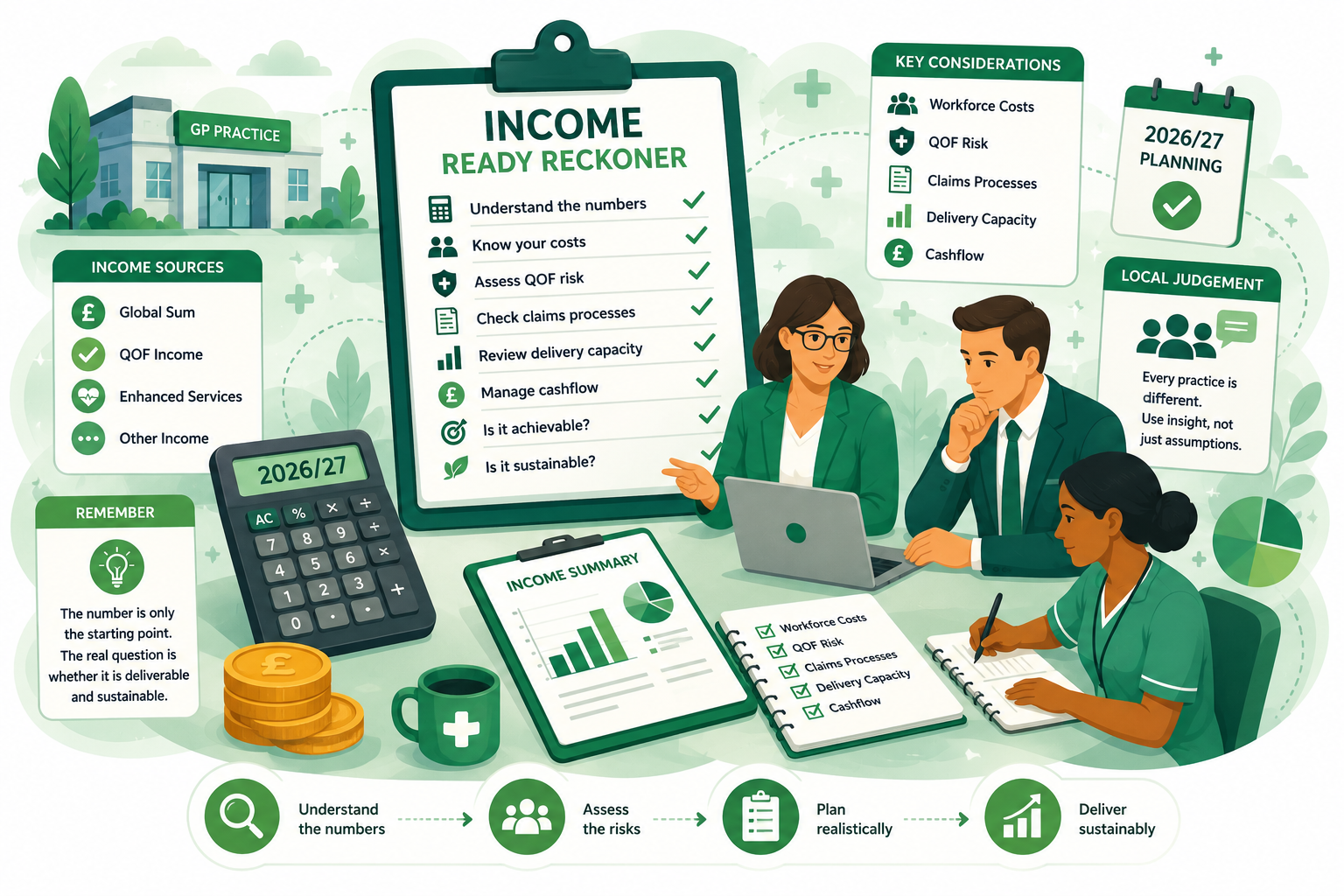
The income ready reckoner is a useful planning tool, but it does not replace local financial judgement. The number is only the starting point. The real question is whether that income is deliverable, sustainable and enough for the workload it is supposed to support.
Income
What might be available?
The ready reckoner helps practices understand the broad financial shape of the year ahead. It can support forecasting, modelling and partner discussions.
Delivery
Can we actually earn it?
Income only matters if the practice has the workforce, systems, appointment capacity, claims process and time to deliver the work behind it.
Sustainability
Is it enough?
A positive income line does not automatically mean the practice is financially stable. Costs, risk, cashflow and workload all need to be understood.
The income ready reckoner is one of those documents that gets a lot of attention in general practice.
Understandably so.
Practices want to know what the contract changes mean in pounds and pence. Partners want to understand likely income. Managers want to model budgets. PCNs want to understand allocations. Finance leads want to know what has moved, what remains, what can be claimed and what assumptions need to be made.
The ready reckoner is useful.
Very useful, in fact.
But here is the catch
The ready reckoner can show possible income. It cannot tell you whether that income is deliverable, sustainable or enough.
It does not know your workforce gaps. It does not know your estates constraints. It does not know whether your salaried GP vacancy has been open for six months. It does not know your locum dependency. It does not know your reception pressure. It does not know whether your online consultation demand has doubled.
It also does not know whether your QOF performance is stable, fragile or held together by one very tired recall lead and a spreadsheet called FINAL_FINAL_v7.xlsx.
The ready reckoner can help you start the financial conversation.
But it cannot have the conversation for you.
A ready reckoner is a model, not a plan
The first mistake is treating the ready reckoner as a finished answer.
It is not.
It is a modelling tool. It helps practices estimate income under the national contract arrangements. It can support planning, comparison and scenario testing. It can help managers and partners understand the broad financial shape of the year ahead.
But a model is only as useful as the interpretation wrapped around it.
Not a budget
It does not replace detailed budgeting, cost assumptions or monthly review.
Not a workforce plan
It does not show whether you have the staff to deliver the income.
Not a risk register
It does not tell you which income streams are fragile or uncertain.
A ready reckoner does not replace a budget. It does not replace cashflow monitoring. It does not replace workforce planning. It does not replace QOF forecasting. It does not replace claims management.
The numbers are the starting point.
Not the end point.
Income is not the same as sustainability
One of the biggest traps in general practice finance is confusing income with sustainability.
A practice can have more income and still be under more pressure.
That may sound contradictory, but it is not.
| Scenario | Why pressure can still increase |
|---|---|
| Income rises, but staffing costs rise faster | The headline income improves, but the margin worsens. |
| Funding is attached to extra activity | The practice needs extra capacity to deliver the work. |
| A reimbursement scheme covers only part of the cost | The wider operational cost may still sit with the practice. |
| Income depends on fragile delivery | If one staff member, one system or one process fails, income is at risk. |
| Payment arrives after costs are incurred | The annual position may look fine, but cashflow still bites. |
The better finance question
What does it cost us to safely deliver the work behind that income?
The contract number is only one version of reality
National finance tools have to simplify. They have to use consistent assumptions, apply national formulas and make the contract calculable across thousands of practices.
That is necessary.
But local practice reality is not standardised.
The model sees the formula
List size, weighted population, national allocations, contract values and assumptions.
The practice sees the reality
Workforce gaps, deprivation, care homes, estates limits, QOF fragility, digital exclusion and demand pressure.
One practice may have high disease prevalence. Another may have high deprivation. Another may be struggling to recruit GPs. Another may have a building that limits room capacity. Another may be dispensing. Another may have a high care home workload.
The ready reckoner gives the national financial frame.
The practice has to add local reality.
Do not look at income without looking at cost
This sounds obvious.
It is often missed.
Practices can spend a lot of time reviewing expected income without giving the same level of attention to the cost of delivery.
That is risky.
- Can the practice recruit?
- Can it offer enough sessions?
- Are there enough rooms?
- Is there supervision capacity?
- Does the additional GP time create genuinely additional capacity?
- Does admin and reception workload also increase?
- Are payroll, pension and employer costs fully understood?
- Does funding timing match salary costs?
- Is the model sustainable beyond the immediate year?
The same principle applies to QOF, enhanced services, PCN funding, digital requirements and access delivery.
Income is only useful if the practice understands the work required to earn, claim or protect it.
The hidden cost of delivery
Some contract income looks simple until you map the work behind it.
A payment may look like a line in a spreadsheet.
In the practice, it becomes work.
Time is the cost that is easiest to underestimate.
A scheme may be financially worthwhile on paper, but if it consumes the capacity of the same staff who are already managing access, QOF, HR, complaints, premises, safety alerts and daily firefighting, then the practice needs to be honest about whether delivery is realistic.
The ready reckoner can show the income. It cannot show the fatigue.
The problem with “available income”
Another trap is assuming that all available income is achievable income.
It is not.
Available income may be conditional. It may depend on claims, coding, thresholds, staff availability, timely data, patient uptake, another organisation doing its part, or a pathway actually working.
That is why practices need to separate income into categories.
Secure income
Income the practice can reasonably expect, subject to normal contractual assumptions.
Claim-dependent income
Income requiring active claiming, evidence, deadlines or system submission.
Performance-dependent income
Income depending on thresholds, indicators, achievement or outcomes.
Capacity-dependent income
Income that only becomes deliverable if the workforce and appointments exist.
Risk income
Income available in theory, but fragile or dependent on factors outside the practice’s control.
Lost opportunity
Income that may be missed if searches, claims, coding or capacity are not managed early.
Once income is viewed this way, the ready reckoner becomes much more useful.
It stops being a single number.
It becomes a planning tool.
Ready reckoner plus local risk register
One practical approach is to review the ready reckoner alongside the practice risk register.
That may sound dramatic.
It is not.
It is just sensible.
| Income area | Possible operational risk |
|---|---|
| QOF income | Recall system depends on limited staff or fragile coding processes. |
| Enhanced service income | Delivery relies on limited nurse capacity or specific trained staff. |
| Access expectations | Same-day urgent demand exceeds available GP or duty capacity. |
| Online consultation requirements | Triage workflow is fragile or poorly resourced. |
| Claims income | Submissions depend on one person or unclear deadlines. |
| PCN income | Delivery depends on recruitment or services outside direct practice control. |
That is not just finance.
That is operational risk.
The strongest practices are not the ones that simply know their income. They are the ones that know which income is safe, which income is fragile and which income needs action now.
The ready reckoner will not tell you your pinch points
A spreadsheet can show expected funding.
It cannot tell you where your practice will break.
That is the job of local management.
These are the places where the financial plan meets the working day.
If the ready reckoner suggests income is available, the next question should be:
The operational question
Where will the work land?
Because if the work lands on people who are already over capacity, the income may not be as useful as it looks.
PCN income still needs practice-level interpretation
PCN funding adds another layer of complexity.
A PCN may receive or model income at network level, but the impact is felt differently by each practice.
The distribution of workload is rarely perfectly even.
- What income sits at PCN level?
- What income flows to practices?
- What is retained centrally?
- What delivery obligations exist?
- Which practice carries which workload?
- How are staff hosted or managed?
- Does the distribution feel fair?
- Is the model sustainable?
A PCN finance line can look tidy.
The delivery underneath can be anything but.
QOF income needs a realism check
QOF is another area where income modelling needs caution.
The ready reckoner may help frame the financial opportunity, but QOF delivery depends on real operational systems.
- Which indicators are historically strong?
- Which indicators are fragile?
- Which rely heavily on one staff member?
- Which require appointment capacity?
- Which need coding improvement?
- Which need searches reviewed?
- Which are affected by patient non-response?
- Which require clinical review rather than admin recall?
- Which indicators are at risk because of workforce gaps?
- Which areas need earlier intervention rather than year-end panic?
The worst time to discover QOF fragility is February.
QOF planning should happen when there is still enough year left to do something about it.
Do not forget cashflow
Profit and loss is one thing.
Cashflow is another.
A practice may be due income, but still feel pressure if expenditure happens before payment.
Annual view
The ready reckoner can support the broad annual forecast and expected income position.
Monthly reality
Payroll, locums, suppliers, premises and delivery costs still need to be paid on time.
A financially sustainable practice needs to know when income is expected, when costs are incurred, what claims must be submitted, who submits them, who checks payment has arrived, what evidence is required, and what happens if payment is delayed or queried.
The ready reckoner may support the annual view.
Cashflow keeps the practice breathing month by month.
Claims management is part of financial governance
A surprising amount of practice income depends on good claims management.
Not heroic finance work.
Just disciplined routine.
A practice can lose income not because it failed to deliver the work, but because the process for claiming it was weak.
| Claims register field | Why it matters |
|---|---|
| Income stream | Identifies what is being claimed. |
| Claim frequency | Shows whether it is monthly, quarterly, annual or ad hoc. |
| Submission route | Prevents confusion over where claims are made. |
| Responsible person | Stops claims depending on memory or assumption. |
| Deadline | Reduces the risk of missed income. |
| Evidence required | Ensures audit trails are ready before submission. |
| Expected value | Allows variance checking. |
| Payment received | Confirms whether income has actually arrived. |
| Follow-up action | Tracks rejected, delayed or queried claims. |
That is basic financial hygiene.
Not fancy.
But useful.
The danger of single-number thinking
The ready reckoner can tempt practices into single-number thinking.
“What is the total?”
That is the natural question.
But it is not enough.
Better finance questions
- What is secure?
- What is variable?
- What is claim-dependent?
- What is at risk?
- What has a delivery cost?
- What requires extra capacity?
- What assumptions are we making?
- What is the worst-case position?
- What actions do we need now?
That is a much more useful conversation than “the spreadsheet says…”
The role of the practice manager
Practice managers sit in the awkward but important space between contract income and operational reality.
They are often the ones who have to translate national finance changes into budgets, forecasts, claims, staffing plans, rota decisions, partner discussions, PCN conversations, QOF monitoring, enhanced service delivery, patient access planning and risk management.
That means the practice manager’s role is not just to report the numbers.
It is to interpret them.
- Finance with workforce.
- Income with workload.
- Contract expectations with real capacity.
- Claims with evidence.
- QOF value with QOF risk.
- PCN income with practice-level delivery.
- Forecasts with decisions.
That is where good practice management adds value.
Not by making the spreadsheet prettier.
Although, obviously, a tidy spreadsheet does calm the soul.
But by making the numbers meaningful.
A practical checklist for using the ready reckoner
The ready reckoner should be part of a wider financial planning process.
A sensible approach would be:
Data that does not change a decision is just decoration.
What good financial planning looks like
Good financial planning in general practice is not just about knowing the contract.
It is about connecting the contract to reality.
- What income do we expect?
- How confident are we?
- What income is at risk?
- What work is required to earn or protect it?
- Who owns each income stream?
- What are the deadlines?
- What are the costs of delivery?
- What assumptions have we made?
- What has changed since the plan was created?
- What decisions do we need to make now?
That is where the ready reckoner becomes powerful.
Not as a standalone answer.
As part of a management system.
Final thought
The ready reckoner is useful.
Practices should use it. They should understand it. They should share it with partners and finance leads. They should use it to support forecasting, planning and scenario discussions.
But they should not confuse it with a practice strategy.
It does not deliver QOF
QOF still needs searches, recalls, coding, clinical review and time.
It does not create capacity
Income does not automatically create rooms, clinicians, appointments or admin support.
It does not manage risk
The practice still needs local judgement, controls, ownership and monthly review.
The ready reckoner does not run the appointment book. It does not recruit the GP. It does not complete the claim. It does not chase the payment. It does not manage demand. It does not absorb staff sickness. It does not create clinical rooms. It does not explain why income looks fine but everyone feels exhausted.
That is the work of practice management.
Final point
The value is not in simply knowing the number. The value is in understanding what sits behind the number.
Because in general practice, income is only one part of the story.
The real question is whether that income is deliverable, sustainable and enough for the workload it is supposed to support.
The ready reckoner can help you start that conversation.
But it cannot have the conversation for you.