- Ben Haresign
- 26 Jun, 2026
- Compliance
- 8 min read
MMR/V Catch-Up Campaign 2026/27: What GP Practices Need to Do
MMR/V Catch-Up Campaign 2026/27: What GP Practices Need to Do
NHS England has confirmed that the national vaccination and immunisation catch-up campaign for 2026/27 will focus on measles, mumps, rubella and varicella vaccination.
This is not simply a request to send a text message. Practices must identify eligible children, reconcile vaccination records, complete a structured call-and-recall process and follow up those who do not respond.
to 31 March 2027
From 12 months to less than six years
Including healthcare-professional contact
For each eligible vaccination administered
Why has MMR/V been selected?
NHS England has selected MMR/V because of recent measles outbreaks and the loss of England's measles elimination status.
Measles is highly infectious and can cause serious complications. The campaign therefore focuses not only on children who are due a routine vaccination, but also those whose records show that one or both doses have been missed.
This is a contractual campaign
Participation in the annual national vaccination catch-up campaign forms part of the GP contract. Funding for undertaking the campaign is included within global sum payments.
MMR or MMRV?
MMRV was introduced into the routine childhood immunisation schedule from 1 January 2026. It protects against measles, mumps, rubella and varicella, commonly known as chickenpox.
For children under six, practices should follow the current childhood immunisation schedule and vaccination history to determine whether MMRV is appropriate. Children aged six and over with an incomplete course will generally continue to be offered MMR where clinically indicated.
Who is included?
Children aged 12 months to 5 years
Practices must undertake local call and recall for registered children in this age group who are missing one or both required doses.
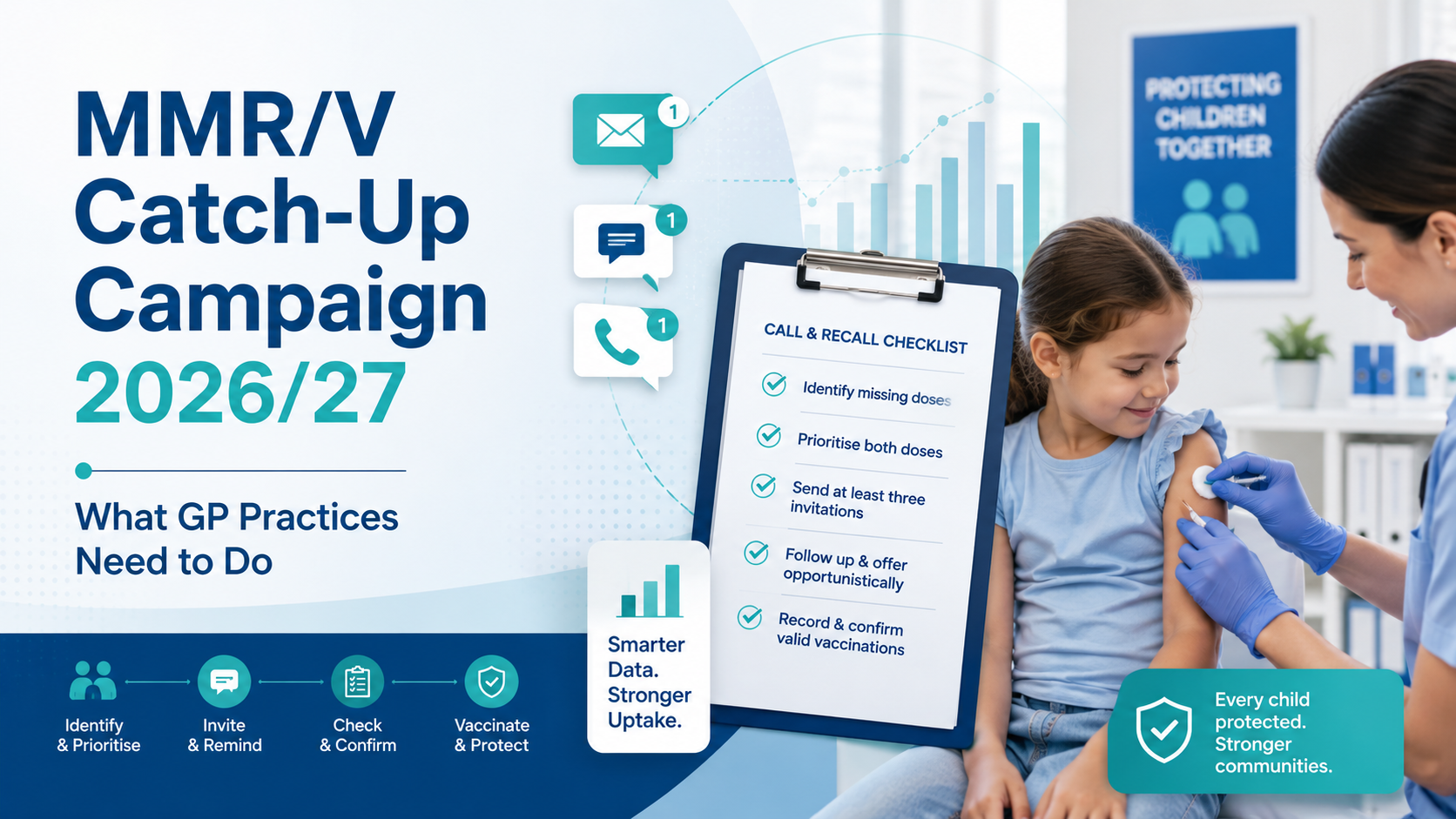
- Identify children missing one or two valid doses.
- Prioritise children missing both doses.
- Send at least three invitations.
- Continue follow-up and opportunistic offers throughout the campaign.
Children aged 6 to 11 years
This cohort will be contacted through a phased national invitation process rather than routine local call and recall.
When a parent or carer contacts the practice, the practice must:
- Check the child’s recorded vaccination history.
- Confirm that previous doses were valid for age and interval.
- Update the clinical record where external vaccination evidence is supplied.
- Arrange vaccination where clinically appropriate.
The required three-stage invitation process
For children aged 12 months to under six, NHS England has specified a minimum of three invitations. The third contact cannot simply be another automated message.
First invitation
Contact the parent or guardian and offer an appointment for vaccination.
Second invitation
Offer another appointment and check whether the invitation was received or whether the family holds evidence of vaccination elsewhere.
Professional discussion
A practice healthcare professional must speak with the parent or guardian, either by telephone or face to face, to support informed choice and address concerns.
A third generic SMS is not sufficient
The published campaign requirements explicitly describe the third invitation as a discussion with a practice healthcare professional. Practices should ensure their searches, recall protocols and audit trails distinguish this contact from an automated invitation.
Start with the records, not the messages
A vaccination search result does not necessarily represent a genuinely unvaccinated child. Vaccinations may have been administered elsewhere, recorded only in scanned correspondence or held within the Child Health Information Service record.
Practices are expected to complete systematic record checks, including:
- Review electronic and relevant paper records.
- Reconcile the practice cohort against CHIS reports.
- Investigate missing or conflicting vaccination entries.
- Code vaccinations contained only in scanned documents.
- Confirm the child remains resident in the practice area.
- Notify CHIS where a child has moved away.
- Check telephone numbers, email and postal addresses.
- Record language, literacy and communication requirements.
Poor coding creates false non-vaccinated cohorts, unnecessary invitations and unreliable QOF data. Data quality is therefore part of the campaign, not an optional tidy-up exercise afterwards.
What happens when families do not respond?
Completing three invitations does not automatically close the process. Practices must continue to review vaccination status and make opportunistic offers when eligible children attend.
Where the required contact process has been completed without a response, NHS England requires practices to:
- notify the school nursing service or school-aged immunisation provider so that follow-up can take place at school;
- inform the local commissioning team of the campaign outcome; and
- use a Make Every Contact Count approach whenever the child or family interacts with the practice.
Make vaccination easier to access
The campaign asks practices to consider more flexible approaches to delivery. This does not necessarily require a large standalone vaccination clinic.
Planned access
- Dedicated catch-up clinics
- Appointments outside school hours
- Sibling appointments
- Booking directly from recall messages
Opportunistic access
- Routine childhood immunisation appointments
- Same-day clinical contacts
- Long-term condition or medication reviews
- Reviewing siblings when another child attends
How practices will be paid
Item-of-service payment
NHS England has confirmed an item-of-service payment of £12.06 for each eligible vaccination given as part of the campaign.
The MMR and MMRV vaccination programme is listed on CQRS as an automated, monthly data collection covering EMIS, TPP and Medicus.
Practices are paid for vaccinations administered by the practice, rather than vaccinations given by another provider and subsequently added to the record.
Watch the age-11 boundary
The campaign letter includes children aged six up to and including eleven. The current CQRS service description separately lists children aged 6–10 and patients aged 11 and over who were previously unvaccinated. Practices should monitor payment extracts for 11-year-olds requiring a second dose and raise any unexplained omissions with CQRS or the commissioner.
Vaccine continues to be available for practices to order through ImmForm.
The QOF connection
Delivery of the campaign may also improve performance against the childhood vaccination QOF indicators.
| Indicator | What it measures | Points | Standard threshold |
|---|---|---|---|
| VI002 | Children reaching 18 months who received at least one MMR or MMRV dose between 12 and 18 months | 18 | 86%–96% |
| VI003 | Children reaching five who received the preschool booster and at least two MMR or MMRV doses between ages one and five | 18 | 81%–96% |
For 2026/27, practices also have an improvement-based route to earning points. Achievement will be assessed using both the standard threshold calculation and improvement against the practice's two-year baseline. The practice will receive whichever calculation produces the higher number of points.
- VI002 begins earning improvement points from an increase of five percentage points, with the upper improvement threshold at 23 points.
- VI003 begins earning improvement points from an increase of five percentage points, with the upper improvement threshold at 30 points.
A practical implementation checklist
Common implementation risks
Do not confuse this with the selective varicella catch-up
A separate selective varicella catch-up programme is due to run from 1 November 2026 to 31 March 2028.
It will apply to eligible children who have not had chickenpox and have not received two varicella-containing vaccinations. Practices should keep the two programmes distinct within searches, invitations, coding and monitoring.
The bottom line
The MMR/V catch-up campaign is as much an operational and data-quality exercise as it is a vaccination clinic.
Practices need a validated cohort, a documented three-stage recall process, sufficient appointment capacity, accurate coding and clear clinical ownership.
Done properly, the campaign can protect children, improve record quality, support QOF achievement and reduce the risk created by unidentified gaps in vaccination coverage.
Official guidance and sources
- NHS England: Confirmation of the national vaccination and immunisation catch-up campaign for 2026/27
- NHS England: General practice vaccination and immunisation standards and contractual requirements
- CQRS: MMR and MMRV Vaccination Programme 2026/27
- NHS England: Quality and Outcomes Framework guidance 2026/27
- UKHSA: Complete routine immunisation schedule from 1 January 2026
Guidance reviewed: 25 June 2026.