- Ben Haresign
- 28 May, 2026
- Access
- 14 min read
Recording the Slot Is Not Managing the Risk
Same-Day Urgent Access: Recording the Slot Is Not Managing the Risk
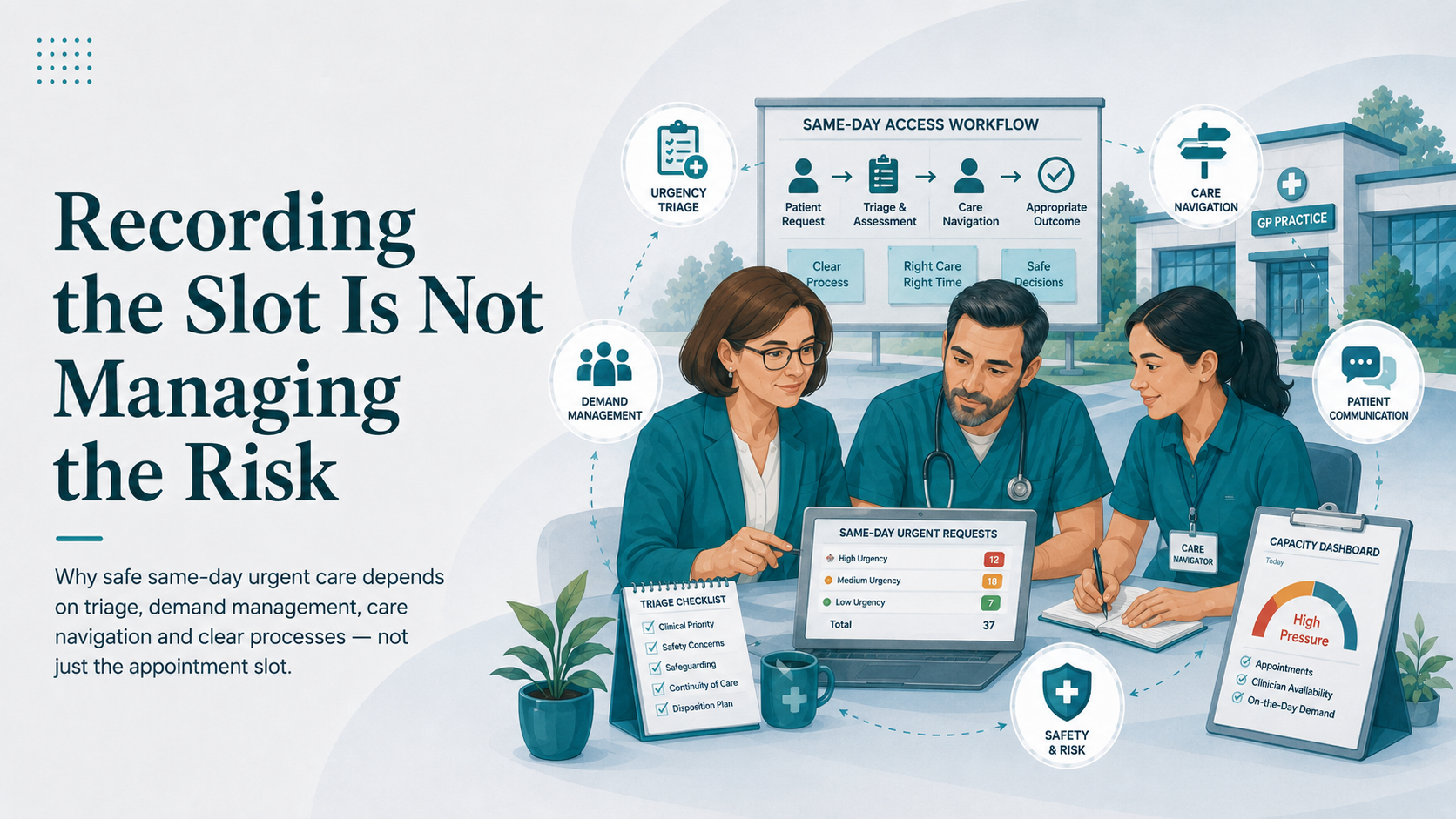
Same-day urgent access is not just an appointment book issue. The appointment slot is where the activity is recorded, but the real risk is managed much earlier: when the request arrives, urgency is identified, capacity is checked and safe action is taken.
Same-day urgent access is going to be one of the most important operational issues for general practice in 2026/27.
The headline sounds simple enough.
If a patient is identified by the practice as clinically urgent, they must be dealt with on the same day.
That sounds like an appointment book issue.
But it is not.
At least, not only.
The key point
The appointment book is where the activity is recorded. It is not where the risk is managed.
The real work happens earlier: when the request arrives, when information is gathered, when urgency is identified, when the patient is routed, when a clinician reviews the concern, when capacity is stretched, and when the practice needs to decide what safe same-day action actually looks like.
That is why same-day urgent access needs to be treated as a safety model, not simply a slot type.
The risk behind the slot
NHS England has published guidance on recording same-day appointments for clinically urgent patients.
The guidance supports the 2026/27 GP Contract requirement that patients identified by the practice as clinically urgent must be dealt with on the same day.
It also sets out how practices should use national appointment categories so that activity can be measured consistently.
That matters.
Good recording helps practices evidence what they are doing. It helps commissioners understand demand. It helps reduce variation in how activity is described. It also helps avoid a situation where practices are doing the work but the data does not show it.
But recording alone does not make an urgent access model safe.
A slot category cannot decide urgency
Clinical urgency depends on the information available at first assessment and the professional judgement applied to it.
A slot category cannot manage deterioration risk
The process needs safe escalation, clinical oversight and clear safety-netting.
A slot category cannot protect staff
Reception and care navigation teams need clear scripts, training and escalation routes.
A slot category cannot create capacity
Recording demand is not the same as having the workforce, appointments and clinical capacity to meet it safely.
The appointment book matters, but it only tells part of the story.
Clinically urgent is a prospective judgement
One of the most important principles is that clinical urgency is judged prospectively.
That means the practice makes a decision based on the information available at the point of first assessment.
It is not a retrospective exercise with the benefit of hindsight.
Why this matters
Patients rarely arrive neatly labelled as urgent, routine, administrative or inappropriate. The practice needs a process that can identify risk when the information is incomplete.
Some patients phone. Some walk in. Some submit an online consultation. Some contact through a carer. Some are routed through community pharmacy. Some concerns appear administrative but have clinical risk underneath.
Some sound urgent but can be safely managed with advice, signposting or planned follow-up.
The challenge is not simply identifying the obviously urgent cases.
It is building a system that can safely identify risk when the information is incomplete.
Same-day does not always mean face-to-face
One trap in this conversation is assuming that “dealt with on the same day” always means a face-to-face GP appointment.
It does not.
- A face-to-face appointment.
- A telephone appointment.
- An online or video consultation.
- Clinical advice.
- Redirection to a more appropriate service.
- Requesting further information.
- A clinician reviewing the request.
- Safety-netting.
- Explaining clearly when and how the patient will receive further information.
The important point is that the practice takes appropriate action based on clinical urgency.
That is very different from saying every urgent request must become a same-day GP appointment.
If practices treat the requirement as simply “create more same-day GP slots”, they risk missing the wider operational issue.
The better question
How do we safely identify, prioritise and act on urgent need across every access route?
The appointment book is the output, not the process
The appointment book is often treated as the heart of access.
In reality, it is the visible end of a much bigger process.
| Before the slot appears | Operational question |
|---|---|
| The patient makes contact | Which route did they use and was it monitored? |
| The request is received | Who received it and what information was collected? |
| Urgency is considered | Was there a safe way to identify clinical risk? |
| The patient is routed | Was the route appropriate for the level of risk? |
| Capacity is checked | Was there safe clinical capacity to act on the request? |
| The action is recorded | Does the appointment category reflect the work actually done? |
If the process behind the slot is inconsistent, the data will be inconsistent.
If the team does not understand what should be recorded as clinically urgent, the reporting will be unreliable.
If reception teams do not have safe escalation routes, the model will carry risk.
If all the focus goes onto coding the slot, the practice may miss the bigger safety question.
The front door is no longer one door
Same-day urgent access used to be easier to picture.
A patient rang the practice. Reception answered. A decision was made. The patient was booked or advised.
That world has gone.
Telephone
The traditional route, but still only one part of the front door.
Walk-in
Patients may present in person with urgent or unclear concerns.
Online consultation
Digital routes still need urgent risk to be identified safely.
Community pharmacy
Pharmacy messages and referrals may contain clinically relevant information.
Care homes
Requests may arrive from carers, nurses or third parties on behalf of patients.
Internal tasks
Risk can sit inside tasks, letters, prescription queries or follow-up messages.
Urgency can appear through any of these routes.
That means the practice cannot design same-day urgent access only around the phone queue.
- Who receives the request.
- What information is collected.
- How urgency is identified.
- When clinical input is needed.
- Who can escalate concerns.
- How the patient is told what happens next.
- Where the activity is recorded.
- How the outcome is coded.
If one route is well managed and another is not, risk will find the gap.
Reception and care navigation need safe escalation routes
Reception and care navigation teams sit at the sharp end of access.
They are often the first people to hear the concern, the frustration, the fear, the vague symptom, the “I just need to speak to someone”, or the “it has been going on for weeks but today it feels worse”.
The same-day urgent access model will only work if those teams are supported.
Scripts help, but are not enough
Staff need clear wording, but they also need to know when and how to escalate uncertainty.
Escalation must be real
If all visible capacity has gone, staff still need a safe route for clinical concern.
Care navigation is not diagnosis
Non-clinical staff should gather information, follow agreed pathways and escalate risk.
Staff need backing
The model only works if staff know they will be supported when they follow the agreed process.
The safest phrase in the system
“I am not sure — I need to escalate this.”
What happens when everything feels urgent?
One of the risks with same-day access is urgency inflation.
When demand is high, everything can start to feel urgent.
Patients feel their own need is urgent. Staff feel pressure to help. Clinicians feel the risk of missing something. Managers feel the pressure of contract expectations, complaints, data and capacity.
Before long, the practice can drift into a model where more and more work is pulled into the same day.
That is not sustainable.
It is also not necessarily safer.
| Type of urgency | Why it matters |
|---|---|
| Clinically urgent | Delay may create clinical risk or deterioration. |
| Administratively urgent | The task may be time-sensitive but not necessarily clinically urgent. |
| Emotionally urgent | The patient may be distressed and need a clear, supportive response. |
| Patient-perceived urgent | The patient may see the issue as urgent, but the clinical route still needs judgement. |
| Routine but important | The issue should not be ignored, but it may not need same-day clinical action. |
| Unsafe to delay | Uncertainty, deterioration risk or red flags should trigger escalation. |
If everything is urgent, prioritisation becomes weaker.
The aim should be to identify clinically urgent need, not to reclassify all demand as same-day demand.
Capacity still matters
It would be easy to say this is all about process.
It is not.
Capacity still matters.
A beautifully designed triage model will still struggle if there is not enough clinical capacity to act on urgent need.
- Enough clinical review capacity.
- Protected duty capacity.
- Safe supervision.
- Realistic appointment templates.
- Clear handling of late-day demand.
- Routes for home visits where needed.
- Links with community pharmacy, urgent treatment centres and other services.
- The ability to escalate sustained pressure to the ICB.
Practices can improve workflow, but they cannot workflow their way out of unlimited demand.
That is where data becomes important.
Not as a performance stick, but as evidence.
From reflection to action
Check what your appointment data is really showing
Recording same-day urgent access is only useful if the data can be understood in context. Use the Haresign GPAD Analyser to explore appointment activity, identify patterns and support more informed access conversations.
Data needs context
Same-day urgent access is linked to appointment recording and national categories.
That is understandable. Without consistent recording, it is hard to measure access.
But data without context can be dangerous.
High same-day urgent activity
This may show good responsiveness, severe demand pressure, broader coding habits or a population with higher need.
Low same-day urgent activity
This may show strong continuity and navigation, or it may show under-recording and hidden urgent work.
The numbers need interpretation.
Practice managers should not wait for someone else to tell the story of their data.
- Are our urgent appointments mapped correctly?
- Are clinicians and admin teams using the same definitions?
- Are telephone, walk-in and online requests recorded consistently?
- Are urgent clinical actions that are not traditional appointments visible?
- Do our appointment categories reflect reality?
- Are we over-recording urgent work because everything feels pressured?
- Are we under-recording because the work is hidden in tasks, messages or duty lists?
- Does our data match what staff experience?
- What local context does the ICB need to understand?
Good data should support improvement.
It should not flatten the reality of practice workload into a single percentage.
The hidden work around same-day urgent access
Same-day urgent access creates more work than the appointment itself.
This hidden work matters because it is often where pressure accumulates.
A practice may technically “deal with” a patient on the same day, but if the follow-up tasks then overwhelm the team, the risk has not disappeared.
It has moved.
That is why practices need to look at the whole pathway, not just the same-day contact.
A practical approach for practices
Same-day urgent access should be reviewed as an end-to-end operating model.
A practical review could start with the following areas.
What good might look like
A strong same-day urgent access model would have several features.
Clear access routes
Patients can contact the practice through the published routes.
Consistent navigation
Staff know how to capture requests and escalate concerns.
Clinical oversight
Urgent or unclear need can be reviewed safely during the day.
Visible recording
Appointment recording reflects the work being done.
Safe communication
Patients receive clear expectations and safety-netting.
Contextual data
Pressure is evidenced and escalated when demand exceeds safe capacity.
That is the difference between recording the slot and managing the risk.
The role of the practice manager
Practice managers have a central role in this.
Not because they are making clinical decisions.
They are not.
But because they sit across the whole operating model.
They understand the appointment system, staffing, patient communication, complaints, premises, digital tools, reporting, ICB expectations, HR pressures and the reality of the working day.
Same-day urgent access cuts across all of those areas.
- Is the process clear?
- Is it safe?
- Is it staffed?
- Is it understood?
- Is it recorded?
- Is it sustainable?
- Does the data reflect reality?
- What happens when it fails?
Those questions are not secondary to the clinical model.
They are what allow the clinical model to function safely.
Final thought
Same-day urgent access is not just a contractual requirement.
It is a test of the whole practice operating model.
It tests the front door
Can patients make contact and be routed safely?
It tests the workflow
Can urgent need be identified, acted on and recorded?
It tests sustainability
Can pressure be evidenced and escalated when capacity is no longer enough?
The appointment slot matters.
The coding matters.
The data matters.
But none of those things replace the need for a safe process behind them.
Final point
Recording the slot is not managing the risk.
Managing the risk means knowing how urgent need is identified, how it is acted on, how patients are kept safe, how staff are supported and how pressure is escalated when capacity is no longer enough.
That is the real work.
And, as ever in general practice, the real work happens long before the data appears on a dashboard.