- Ben Haresign
- 31 May, 2026
- CQC
- 15 min read
CQC Readiness Is Not a Folder: It Is How Your Practice Runs
CQC Readiness Is Not a Folder
It is how your practice runs.
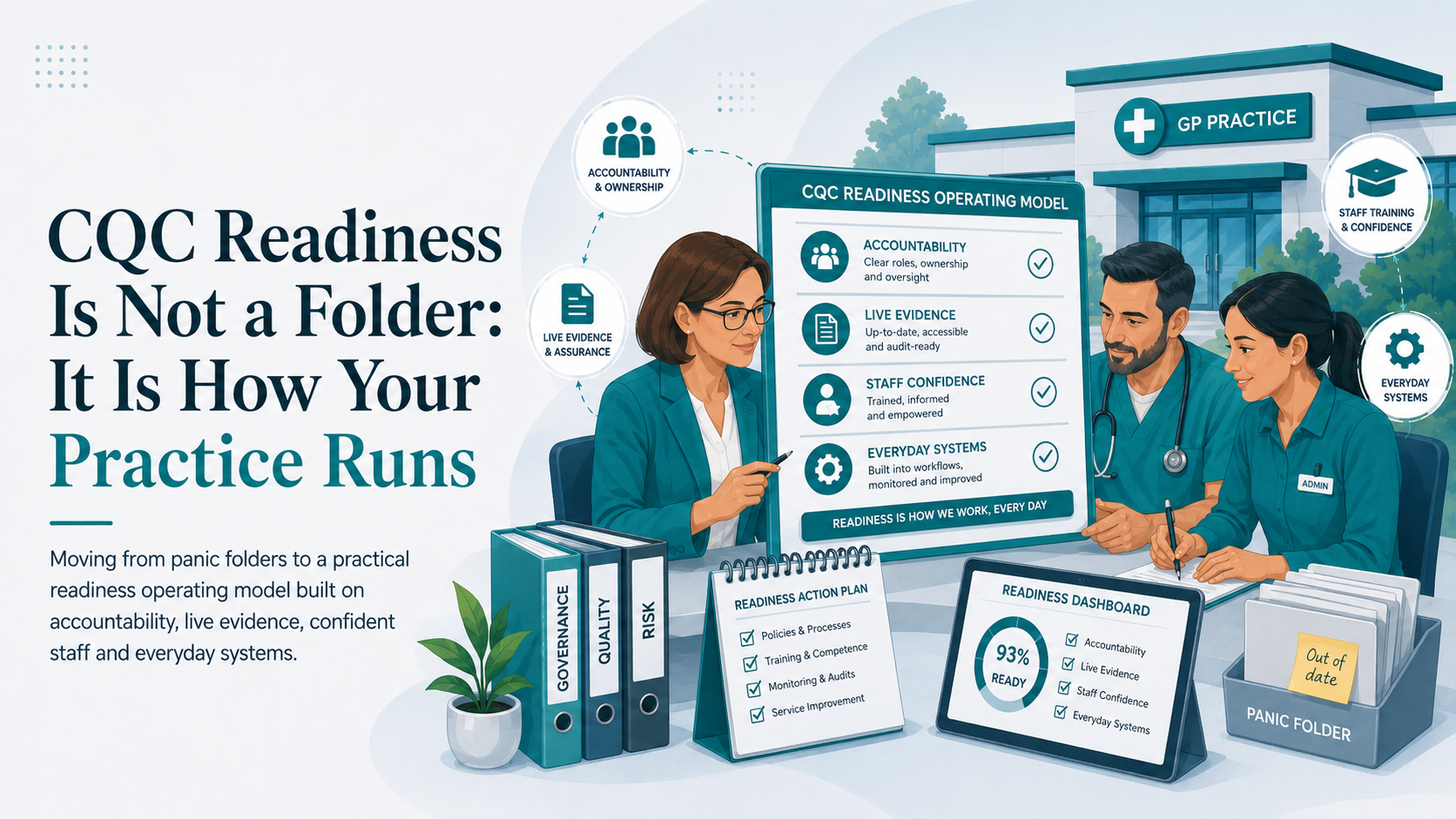
CQC readiness is not about creating a tidy folder two weeks before an inspection. It is about having clear accountability, live evidence, confident staff and systems that show the practice is safe, organised and learning every day.
Practical tool
Check your CQC readiness
Use the CQC Returning to Good tool to work through key evidence areas, identify gaps and turn readiness into an action plan.
Open the CQC toolCore principle
Stop building panic folders
Strong CQC evidence comes from live governance, clear ownership, staff confidence and a practice that can explain how it works.
View the readiness modelCQC readiness is often talked about as if it is a document exercise.
Create the folder. Update the policies. Check the training spreadsheet. Make sure the fire risk assessment is somewhere sensible. Hope nobody asks a difficult question.
But that is not real readiness.
Real CQC readiness is not about having a folder that looks tidy before inspection. It is about being able to show, clearly and confidently, how the practice runs every day.
Weak evidence
“We have a policy for that.”
Stronger evidence
“This is who owns it, this is how we monitor it, this is what changed when we found a gap, and this is how staff know what to do.”
That is the standard practices should be aiming for.
A well-prepared practice does not need to panic when inspection is mentioned. It already has a working system. The evidence is not artificially created for CQC. It is generated naturally through good governance, safe processes, clear accountability and regular review.
The problem with the “CQC folder” mindset
The traditional CQC folder can give a false sense of security.
A practice may have policies, templates, certificates, meeting notes and trackers, but still struggle to evidence how those things are used. A policy that nobody reads is not strong evidence. A spreadsheet that is not reviewed is not oversight. A meeting note without actions is not learning. A risk register that never changes is not risk management.
The five evidence questions
| Question | What it proves |
|---|---|
| Who owns this? | Accountability |
| When was it last checked? | Oversight |
| What changed because of it? | Learning and improvement |
| Can staff explain it? | Embedded practice |
| Can we evidence it quickly? | Inspection readiness |
If a practice can answer those five questions across safeguarding, complaints, significant events, recruitment, training, premises, infection control, information governance, access and medicines safety, it is in a much stronger position.
That is the shift.
Not “where is the document?”
But “how do we know this is working?”
1. Start with accountability: who owns what?
One of the most useful pieces of CQC evidence is a clear management and responsibility structure.
This does not need to be complicated, but it does need to be honest. It should show who leads on key areas, who provides cover, how issues are escalated and where evidence is stored.
Clinical governance
Safeguarding, significant events, medicines safety, safety alerts and clinical risk.
Operational governance
Complaints, access, appointment books, policies, business continuity and contracts.
Workforce and premises
Staff files, training, DBS checks, estates, fire safety, COSHH and equipment checks.
For example, a practice should be able to show clear ownership for:
- complaints
- significant events
- safeguarding
- infection prevention and control
- health and safety
- fire safety
- staff training
- recruitment checks
- information governance
- policies
- QOF and contract monitoring
- patient access
- premises compliance
- emergency equipment
- business continuity
This is where many practices become vulnerable. They may have capable people doing the work, but the responsibility is informal, undocumented or dependent on one person knowing everything.
That becomes a risk.
Example CQC responsibility matrix
| Area | Lead | Deputy | Review frequency | Evidence location | Escalation route |
|---|---|---|---|---|---|
| Safeguarding | Named lead | Deputy lead | Monthly / quarterly | Meeting log | Partners / clinical lead |
| Complaints | Practice manager | Admin lead | Monthly | Complaints log | Partners |
| Premises safety | Operations lead | Deputy manager | Monthly | Estates tracker | Business manager / partners |
| Staff training | HR / admin lead | Practice manager | Monthly | Training tracker | Management meeting |
| Significant events | Clinical lead | Practice manager | Monthly | SEA log | Clinical meeting |
This gives CQC, staff and the partnership a clear view of how the practice is governed. It also protects the practice operationally. If the manager is away, the system should still function. Readiness cannot live in one person’s head.
2. Staff confidence is evidence
CQC readiness does not stop with managers and partners.
Staff need to know what to do in the situations that matter. This includes reception, administration, nursing, dispensary, ARRS staff, trainees and clinicians.
A useful way to test this is not through a formal exam, but through a staff confidence check.
- Who the Freedom to Speak Up Guardian is
- How to raise a safeguarding concern
- What may indicate risk to a child or adult
- What an information governance breach is
- How a patient can make a complaint
- Where policies are stored
- How they know a policy has changed
- What to do if the fire alarm sounds
- Where the fire assembly point is
- Where the defibrillator is kept
- Where emergency equipment is kept
- How safety alerts are shared with clinicians
These are simple questions, but they reveal a lot.
If only one or two people know the answers, the process is fragile. If the wider team can answer confidently, the practice can demonstrate that safety processes are understood, not just written down.
A staff confidence check can be repeated every six or twelve months, discussed at a team meeting and used to identify training gaps.
The evidence is not just the completed quiz. The evidence is what the practice did with the answers.
3. Safeguarding evidence needs to show oversight, not just concern
Safeguarding is one of the clearest areas where practices need to evidence active oversight.
It is not enough to say that staff know how to raise concerns. The practice should be able to show that concerns are reviewed, discussed, acted on and followed up.
A strong safeguarding meeting record should include:
The concern
Category, source of concern, summary of risk and relevant background.
The action
Lead responsible, actions agreed, referrals made, coding or alerts added.
The follow-up
Review date, outcome, wider learning and any themes for the practice.
The key is to move away from a passive list of cases and towards an active safeguarding oversight log.
Weak
Safeguarding concern discussed. Relevant codes added.
Stronger
Concern reviewed at safeguarding meeting. Risk level agreed. Named GP to review record and contact health visitor/social care where appropriate. Alert added. Follow-up scheduled for next safeguarding meeting. Learning point shared with reception team regarding escalation of third-party concerns.
That tells a very different story.
It shows the practice is not only aware of safeguarding risk, but actively managing it.
4. Estates and premises evidence matters more than people think
Premises evidence can feel like the dull end of CQC preparation.
Fire alarms. PAT testing. Calibration certificates. Legionella reviews. COSHH assessments. Emergency lighting. Fridge checks. Boiler servicing.
Not glamorous. Not exciting. Very much the beige cardigan of compliance.
But premises safety is directly linked to safe care.
Fire safety
Fire risk assessment, alarm testing, extinguisher servicing and emergency lighting checks.
Building safety
Fixed wire testing, gas safety certificate, boiler servicing and maintenance records.
Clinical safety
Calibration, vaccine fridge checks, emergency equipment checks and oxygen checks.
Water safety
Legionella risk assessment, review records and water temperature checks where applicable.
COSHH
Substance assessments, safety data sheets, control measures, PPE and disposal arrangements.
Infection control
Cleaning schedules, waste management, sharps disposal and IPC audit actions.
The important word here is live.
An estates tracker should not simply record that something exists. It should show:
- date last completed
- next review date
- responsible person
- current status
- gaps or overdue actions
- evidence location
- action taken
This turns estates compliance from a collection of certificates into a management system.
5. COSHH is not just a template exercise
COSHH assessments are a good example of where practices can hold paperwork without necessarily having assurance.
A COSHH assessment should clearly identify:
- the substance
- supplier or manufacturer
- safety data sheet reference
- task being undertaken
- hazard statements
- precautionary statements
- exposure risk
- who may be affected
- health effects
- PPE required
- control measures
- first aid treatment
- storage requirements
- disposal and spillage arrangements
The practical question is whether staff using the substance understand the control measures.
For example, if a cleaning product requires gloves, ventilation or specific storage, that should not just sit inside a document. It should be reflected in staff practice.
Again, the aim is not beautiful paperwork. The aim is safe use, clear controls and evidence that the practice has reviewed the risk.
6. Risk assessments should show judgement, not just scores
Risk assessments are not there to make the practice look risk-free. They are there to show that risks are understood, controlled and reviewed at a proportionate frequency.
A useful risk assessment should include the hazard, who may be affected, likelihood, severity, current controls, additional controls, owner, timescale and residual risk.
- brief task or issue description
- risk assessment reference
- hazard and consequence
- who may be affected
- likelihood and severity rating
- existing control measures
- additional controls required
- implementation owner
- implementation timescale
- residual risk after controls
- manager approval
- planned review date
Suggested review frequency
| Risk level | Suggested review frequency |
|---|---|
| Very high | Review at least every 1–3 months |
| High | Review at least every 6–12 months |
| Moderate | Review at least every 12–18 months |
| Low | Review at least every 18–24 months |
This is where risk assessment becomes useful evidence. It shows that the practice is not trying to remove every possible risk, but is making sensible, documented and proportionate decisions.
7. Workforce compliance is CQC evidence
Staff files and HR trackers are often viewed as internal administration. In reality, they are part of CQC readiness.
A practice should be able to evidence that staff are recruited safely, trained appropriately and reviewed regularly.
- identity checks
- right to work
- DBS status, where applicable
- references
- employment history and gaps
- contract issued
- confidentiality agreement
- induction completed
- mandatory training
- role-specific training
- professional registration
- immunisation evidence, where relevant
- appraisal date
- declarations and ongoing suitability checks
The tracker should not exist simply to say “yes” or “no”. It should support active management.
| Staff member | Area | Status | Gap | Action | Owner | Due date |
|---|---|---|---|---|---|---|
| Receptionist | Mandatory training | Amber | Fire training due | Book refresher | Admin lead | 30 days |
| Nurse | Professional registration | Green | None | Recheck next cycle | Practice manager | Annual |
| New starter | Induction | Amber | Chaperone training pending | Complete module | Line manager | 14 days |
This gives the practice a clear view of workforce risk.
It also helps avoid the classic last-minute inspection scramble, where someone suddenly tries to locate five years of certificates from seven inboxes and a dusty USB stick named “training old maybe final final”.
8. Gaps are not always failures — unmanaged gaps are
One of the most important parts of CQC readiness is being honest about gaps.
No practice has perfect historical records, perfect premises evidence or perfect workforce files. The issue is not whether a gap has ever existed. The issue is whether the practice knows about it, has assessed the risk, put proportionate controls in place and documented the decision.
For example, a historic missing reference for a long-standing member of staff may not require the same response as a missing reference for a new starter. The practice should consider the context, the person’s length of service, DBS status, proof of qualifications, role, supervision, performance history and whether there is any actual concern.
The important part is documenting the judgement. This turns a weakness into evidence of active governance.
- what the gap is
- who may be affected
- the likelihood and severity of risk
- existing controls already in place
- additional controls required, if any
- who approved the decision
- whether the risk needs future review
This is the difference between “we are missing a document” and “we identified a historic issue, assessed the risk and recorded why the current controls are proportionate.”
9. Policies need ownership, not just storage
Policies are another area where practices can appear prepared but lack real assurance.
Having policies stored somewhere is only the first step.
A practice also needs to know:
- who owns each policy
- when it was last reviewed
- when it is due for review
- whether staff have been told about updates
- whether the policy reflects actual practice
- whether any changes require training or communication
- whether the policy has been approved through the correct route
Example policy tracker
| Policy | Owner | Last reviewed | Next review | Changes made | Staff communication | Approved by |
|---|---|---|---|---|---|---|
| Complaints policy | Practice manager | Jan 2026 | Jan 2027 | Updated contact route | Team meeting | Partners |
| Safeguarding policy | Safeguarding lead | Mar 2026 | Mar 2027 | Local pathway updated | Clinical meeting | Partners |
| Fire policy | Operations lead | Apr 2026 | Apr 2027 | Assembly point clarified | All staff email | Partners |
10. Complaints, significant events and learning
CQC will not expect a practice to be perfect.
They will expect the practice to identify problems, respond appropriately and learn.
This is why complaints and significant events are so important. They show how the practice listens, reflects and improves.
- what happened
- who was affected
- immediate action taken
- investigation outcome
- patient response, where relevant
- learning identified
- action agreed
- owner
- due date
- completion evidence
- whether learning was shared
- whether the change was reviewed later
The final step is often missed.
Practices record the event, discuss it, agree an action — and then never close the loop.
That is what turns an event log into a learning system.
11. Well-led includes how you support staff
CQC readiness is not only about policies, premises and trackers. It is also about whether the practice creates a safe and supportive environment for staff.
Staff wellbeing evidence does not need to be overcomplicated. A practice should be able to show that staff know where to access support, how to raise concerns, how to speak up and where to find help when work or life pressures become difficult.
- Freedom to Speak Up information
- mental health and wellbeing support routes
- financial wellbeing support signposting
- domestic abuse support signposting
- drug and alcohol support resources
- supervision, appraisal and return-to-work processes
- team meeting evidence showing staff concerns are heard
This helps evidence a culture where staff are supported, concerns can be raised and the practice recognises that workforce wellbeing is directly linked to safe patient care.
Practical next step
Turn the guide into action
Reading about CQC readiness is useful, but the real value comes from testing your own systems. Use the CQC Returning to Good tool to work through key evidence areas, identify gaps and turn readiness into a clear action plan.
12. Build a monthly CQC readiness rhythm
The best way to stay ready is to stop treating CQC as a separate project.
Instead, build readiness into the normal management cycle.
| Frequency | Action |
|---|---|
| Weekly | Review urgent risks, incidents, safety alerts, premises issues and complaints received. |
| Monthly | Review training gaps, safeguarding cases, significant events, complaints, estates tracker and policy deadlines. |
| Quarterly | Deep dive one CQC domain: safe, effective, caring, responsive or well-led. |
| Six-monthly | Run staff confidence checks, emergency equipment review, access review and business continuity review. |
| Annually | Complete the full policy review cycle, premises compliance review, workforce file audit and CQC evidence review. |
This creates a steady system.
It also makes inspection preparation far less stressful. Instead of trying to build evidence retrospectively, the practice is continually generating it.
13. The CQC readiness operating model
A simple model for practices is:
1. Assign ownership
Every key area should have a named lead and deputy.
2. Track compliance
Use live trackers for workforce, premises, policies, safeguarding, complaints and events.
3. Review regularly
Build compliance review into management and clinical meetings.
4. Evidence action
Do not just record that something was discussed. Record what changed.
5. Test staff awareness
Use confidence checks, team meetings and induction refreshers.
6. Close the loop
Check whether actions were completed and whether they worked.
This is what makes CQC readiness real.
CQC readiness is the by-product of a well-run practice
The strongest practices are not necessarily the ones with the prettiest folders.
They are the ones that can explain how they work.
They know who owns each area. They know where the risks are. They can show what they have reviewed. They can explain what changed. Their staff understand the basics. Their evidence is accessible. Their systems continue even when key individuals are away.
That is real readiness.
The goal is not to perform for inspection.
The goal is to build a practice that is safe, organised, responsive and able to evidence the work it is already doing.
Because when the day comes, the most powerful answer is not: “We created this for CQC.”
It is: “This is how we run the practice.”