- Ben Haresign
- 05 Jun, 2026
- General Practice
- 13 min read
Operational Debt: The Hidden Drag on General Practice
Operational Debt: The Hidden Drag on General Practice
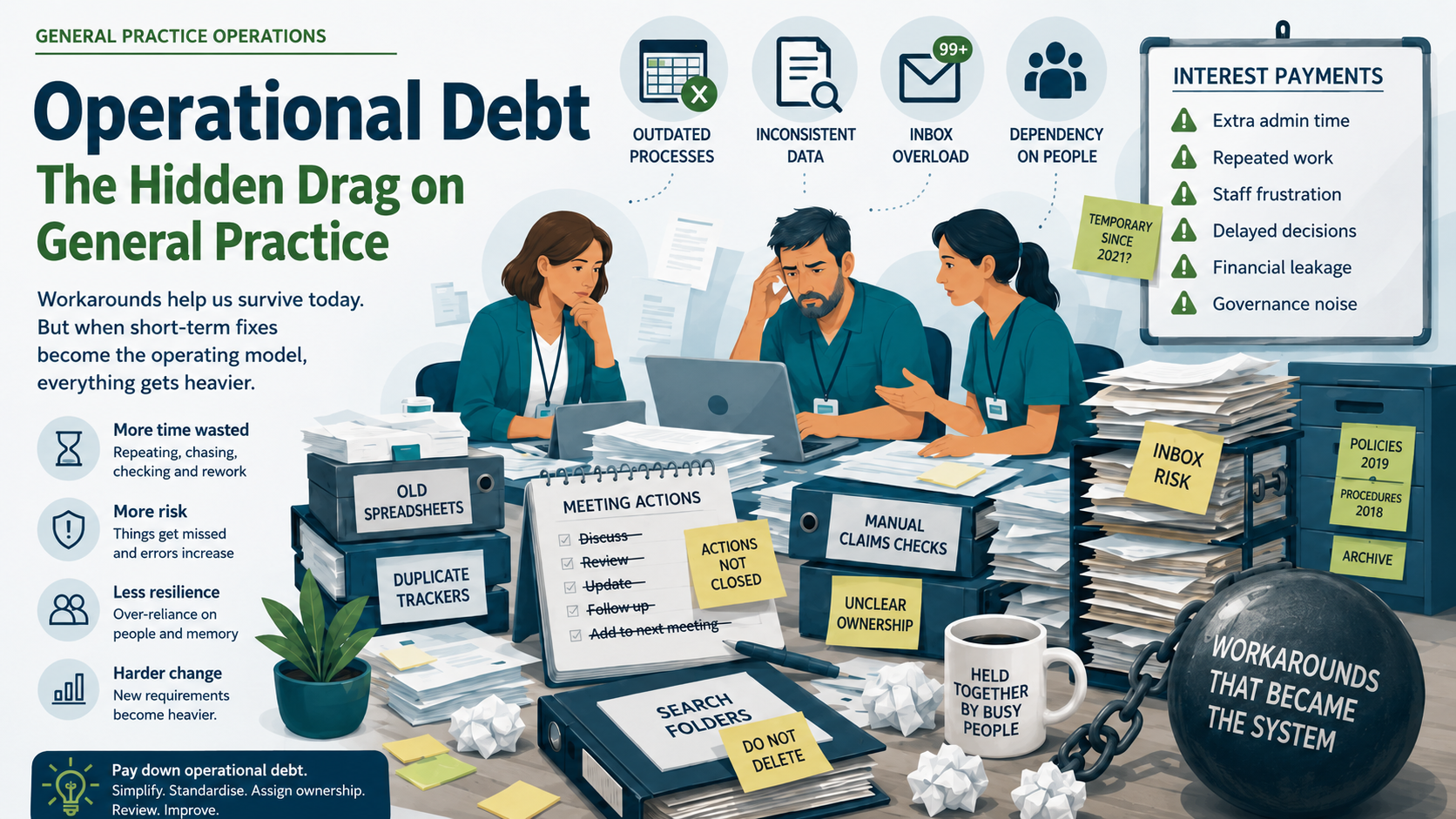
Operational debt builds when today’s workaround becomes tomorrow’s normal process. In general practice, old spreadsheets, duplicated trackers, unclear ownership and inherited routines can quietly slow teams down, increase risk and make every new requirement harder to deliver.
Every workaround has a cost. Some are necessary. Some are harmless. Some quietly become the reason everything feels harder than it should.
In this article
- ✓ What operational debt means
- ✓ Why it builds up in practices
- ✓ Where it creates risk
- ✓ How to spot the warning signs
- ✓ How to start paying it down
General practice is very good at keeping going.
That is one of its greatest strengths. When something changes, when a service specification lands, when a member of staff leaves, when a system does not quite work, or when a new request arrives with almost no notice, practices usually find a way through.
A spreadsheet is created. A manual check is added. Someone starts keeping a list. A meeting action is carried forward. A search is copied. A rota pattern is tweaked. A process is held together by the person who knows “how we normally do it”.
At first, that is often reasonable. General practice cannot stop every time a process is imperfect.
But over time, those temporary fixes can become permanent ways of working. The workaround becomes the process. The process becomes the habit. The habit becomes invisible.
That is operational debt.
It is the hidden cost a practice carries when short-term fixes, duplicated processes and unclear ownership are allowed to become part of the operating model.
It may not appear on the balance sheet, but it behaves like debt. It attracts interest. The longer it remains unresolved, the more effort it takes to run the practice safely, consistently and efficiently.
What is operational debt?
Operational debt is the accumulated burden of workarounds, outdated processes, duplicated systems, unclear ownership and inherited habits that make everyday work harder than it needs to be.
In general practice, it often looks perfectly ordinary from the outside. It rarely announces itself as a major failure. More often, it hides inside the small frictions that staff have learned to tolerate.
Old spreadsheets
Trackers that started as a quick fix but are now relied upon for claims, recalls, HR, QOF, premises or CQC evidence.
Copied searches
Searches that have been moved forward year after year, but nobody is fully confident they still reflect current requirements.
Inbox management by memory
Important work sitting in email chains, waiting for someone to remember the context, the deadline and the next step.
Unclear ownership
Everyone knows something needs doing, but no one is clearly accountable for making sure it is completed and checked.
Manual claims checks
Income processes that depend on one person knowing what to check, where to check it and when to submit it.
Meetings without closure
Actions are recorded, discussed again, carried forward, renamed, and then quietly absorbed into the background noise.
None of these things necessarily mean a practice is badly run. In fact, operational debt often appears in busy, capable teams because they are constantly adapting.
The problem is not that workarounds exist. The problem is when they are never reviewed, simplified, retired or converted into proper systems.
Why operational debt builds up
Operational debt rarely appears because people are careless.
It appears because people are busy.
General practice has an almost endless ability to absorb new work. New specifications arrive. Contract requirements change. CQC expectations evolve. Workforce returns need updating. Access models are adjusted. Digital routes expand. Enhanced services are layered on top of core work. Patients expect faster responses. Staff need training, support and supervision.
The practice still has to open the doors, answer the phones, process the prescriptions, review the results, manage the rota, handle complaints, submit claims and keep patients safe.
Urgent work beats important work
The process improvement that would save time next month loses to the issue that needs fixing by 3pm today.
New work is added before old work is removed
A new digital tool, tracker or report is introduced, but the previous process quietly continues alongside it.
Knowledge sits with individuals
The system works because someone remembers what to do, not because the process is clear, documented and resilient.
The workaround mostly works
If something is not visibly failing, it can feel safer to leave it alone, even when everyone knows it is clunky.
This is how practices end up carrying processes that nobody would design from scratch, but everyone has learned to live with.
How operational debt shows up in daily practice life
Operational debt is not always obvious because it often feels like normal pressure. It becomes part of the background.
But there are warning signs.
Common symptoms
- Everyone is busy, but nothing feels properly finished.
- The same questions are asked repeatedly.
- Reports need manual cleaning every month.
- Managers rely on memory to know what is happening.
- Staff are unsure which tracker is the correct one.
- New starters learn by folklore rather than process.
- Meetings create more actions than they close.
- Claims depend on one person remembering the rules.
- CQC evidence is collected in a rush.
- Searches show work, but ownership is unclear.
- Temporary trackers become permanent infrastructure.
- Small changes require far too much chasing.
These symptoms matter because they are not just admin irritations. They are signals that the practice is paying interest on old decisions.
Every time someone has to remember, chase, correct, duplicate, explain or manually reconcile something that should have been clear in the first place, the practice is paying interest on operational debt.
Why operational debt matters
Operational debt matters because it quietly weakens the ability of a practice to deliver safely and consistently.
It is easy to dismiss it as “just admin”. But in general practice, admin is often the structure that holds clinical safety, access, finance, governance and patient experience together.
It creates risk
Things get missed when processes depend on memory, goodwill or one person knowing where everything is.
It wastes time
Teams repeat work, chase information, maintain duplicate lists and manually correct avoidable issues.
It hides accountability
Everyone knows the problem exists, but nobody is clearly responsible for fixing it and checking the outcome.
It weakens resilience
If a process only works when a particular person is in the building, it is not a resilient process.
It damages confidence
Staff lose trust in systems when they constantly have to check, re-check and ask which version is correct.
It makes change harder
New contracts, CQC requirements, access changes and workforce planning all become harder when the operating model is already cluttered.
Operational debt is not always dramatic. That is what makes it dangerous. It does not always cause an immediate failure. It just makes everything heavier.
Where practices often carry operational debt
Every practice will have different pressure points, but there are common areas where operational debt tends to accumulate.
| Area | What operational debt can look like | Why it matters |
|---|---|---|
| Access | Slot types, session templates or booking rules no longer match actual demand. | Capacity appears available on paper but does not work properly in reality. |
| QOF | Searches identify work, but ownership, recall routes and exception processes are unclear. | Income and patient care become dependent on manual chasing. |
| HR | Training records, appraisals, DBS checks and role documents live in different places. | Compliance becomes difficult to evidence and easy to miss. |
| Finance | Claims are checked manually or rely on one person knowing the rules. | Income risk increases and financial planning becomes less reliable. |
| CQC | Evidence exists, but it is not live, organised or easy to retrieve. | Good work becomes harder to demonstrate when it matters. |
| Policies | Documents are approved but not embedded into everyday working. | The practice can evidence a document, but not necessarily a working process. |
| Workforce | Role mix is recorded but not actively reviewed against demand, income and resilience. | The practice may appear staffed but still feel fragile. |
| Meetings | Actions are raised repeatedly but not closed, escalated or reviewed properly. | Governance becomes a conversation rather than a control system. |
| Digital tools | New systems are added without removing old manual work. | Technology creates another layer instead of reducing friction. |
| Data quality | Coding variation, old templates and inconsistent recording affect reporting. | Decisions are made using data that may not reflect reality. |
The pattern is usually the same: the practice has found a way to make something work, but the process has become too dependent on manual effort, memory or duplicated systems.
The interest payments of operational debt
Financial debt charges interest in money.
Operational debt charges interest in time, energy, attention and risk.
More checking, chasing and reconciling than the process should require.
Tasks repeated because the first process was unclear or incomplete.
People feel busy, blocked and unsure which process to trust.
Managers spend time finding the truth before they can act on it.
Claims, coding and contract delivery become harder to track reliably.
Meetings discuss problems repeatedly because the system has not resolved them.
The practice pays interest every time someone has to remember, chase, correct, duplicate or explain a process that should have been clear in the first place.
How to start paying operational debt down
The answer is not to launch a huge transformation programme every time something feels messy.
Most practices do not have the time, capacity or appetite for that. Paying down operational debt usually starts with small, deliberate improvements that remove friction from the system.
Start small, but start deliberately.
Choose one area where repeated friction is costing time, creating risk or relying too heavily on one person. Then simplify it, document it, assign ownership and review whether it actually improved.
The 5-question operational debt check
What process causes repeated friction?
Look for the task people complain about, avoid, duplicate or repeatedly ask for help with.
Where are we relying on memory?
If the answer is “ask Sarah, she knows”, the process may be more fragile than it looks.
What are we duplicating?
Identify where the same information is being maintained in more than one place.
Who owns the fix?
A problem without an owner is usually just a recurring agenda item.
What can we simplify, stop or standardise?
Improvement is not always about adding something. Often, it is about removing clutter.
Paying down operational debt does not need to be dramatic. It might mean removing one duplicated tracker, reviewing one search folder, documenting one fragile process, closing one recurring action properly or replacing one manual claim check with a repeatable system.
Practical places to start
If the phrase “operational debt” feels too abstract, start with the areas where the practice already feels friction.
What not to do
It is very easy to respond to operational debt by adding another layer of management on top of the existing mess.
That usually makes things worse.
Avoid creating more admin to manage the admin
- Do not launch another spreadsheet without retiring an old one.
- Do not introduce a tool without changing the workflow around it.
- Do not create an action log that nobody reviews.
- Do not hold a meeting if nobody in the room can make a decision.
- Do not assume “known by the manager” is a safe process.
- Do not mistake more reporting for better control.
You cannot pay down operational debt by creating more operational debt.
The aim is not to produce a perfect process map for everything in the building. The aim is to reduce the number of things that depend on memory, duplication, chasing and heroic effort.
Operational debt is also a culture issue
Some operational debt is technical. Some of it is cultural.
Practices can accidentally build cultures where workarounds are admired more than prevention. The person who fixes the crisis is noticed. The person who quietly redesigned the process so the crisis does not happen again may be less visible.
Both matter, but sustainable practice management needs to value prevention.
A reactive culture asks:
- Who can fix this today?
- Can someone chase it?
- Can we make a quick tracker?
- Can we just add it to the next meeting?
A resilient culture asks:
- Why did this become difficult?
- Where did the process fail?
- Who owns this properly?
- What can we remove, simplify or standardise?
The difference is subtle, but important. One culture survives by constantly patching. The other improves by learning where the patches are no longer enough.
The safest practices notice where the system is creaking
Operational debt is not always visible, but teams feel it every day.
It is in the repeated chase, the manual workaround, the unclear owner, the spreadsheet that nobody fully trusts and the meeting that never quite closes the loop.
General practice will always need flexibility. That is part of the job. But flexibility is not the same as fragility.
The aim is not to remove every workaround overnight. Some workarounds are necessary, especially in a system that changes as quickly as general practice does.
The real challenge is to notice when a workaround has stopped being helpful and has started becoming part of the problem.
The safest practices are not the ones with no problems. They are the ones that notice where the system is creaking — and make time to fix it.
Questions for your practice
If you want to start a practical conversation about operational debt, these questions are a useful place to begin:
- Which process currently causes the most repeated friction?
- Where are we maintaining the same information in more than one place?
- Which important process depends too heavily on one person?
- Which meeting action has been carried forward too many times?
- Which tracker, search or report do staff no longer fully trust?
- What could we stop doing without reducing safety or quality?
- What is one operational debt we could pay down this month?
Final thought
Workarounds help practices survive. Systems help practices breathe. The trick is knowing when one needs to become the other.