- Ben Haresign
- 18 Jun, 2026
- Compliance
- 12 min read
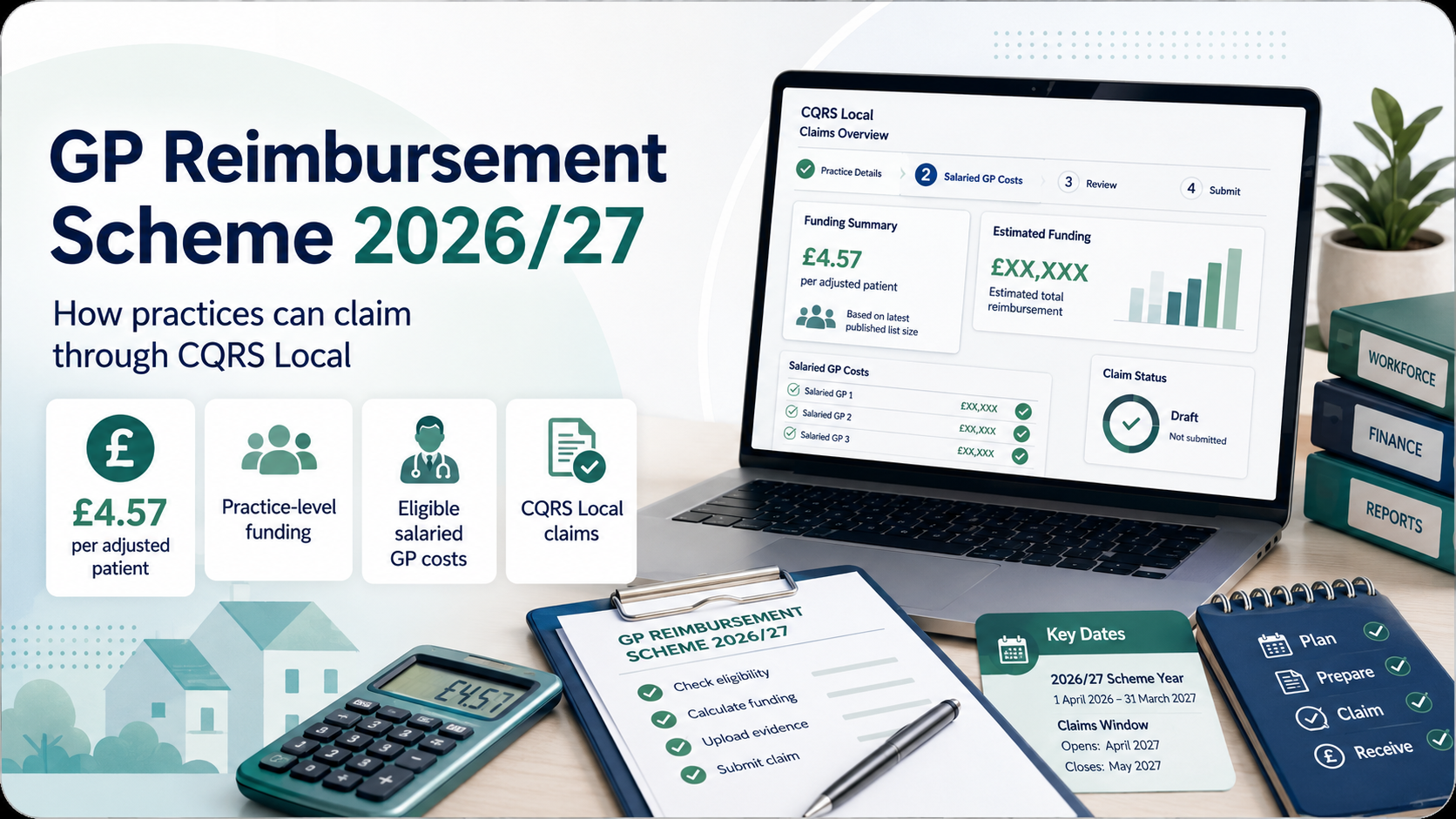
GP Reimbursement Scheme 2026/27: How Practices Can Claim Through CQRS Local
The Practice Level GP Reimbursement Scheme is now live. Here is how to calculate your funding entitlement, determine which GP costs qualify and submit claims through CQRS Local.
An update to our original Capacity and Access Payment analysis
This article follows our earlier guide, Capacity and Access Payment 2026/27: What Practices Need to Do Now . The operational guidance has since been published, confirming the funding caps, eligibility rules and CQRS Local claims process.
The scheme replaces the former PCN-level Capacity and Access Payment and moves £292 million of recurrent funding directly to individual practices.
Practices can use the funding to employ a new salaried GP, increase the hours of an existing salaried GP or, in certain circumstances, continue a GP post previously funded through the PCN Capacity and Access Payment or Test Sites programme.
Claims are submitted through CQRS Local and approved by the practice’s integrated care board.
This guide explains what your practice can claim, how much funding is available, the additionality rules and what needs to be done now.
What has changed?
Until 31 March 2026, Capacity and Access Payment funding formed part of the Network Contract DES and was paid at PCN level.
From 1 April 2026, that funding was removed from the DES and repurposed as a practice-level reimbursement scheme.
The key change is not simply a new name. Responsibility has shifted:
- the funding entitlement belongs to the individual practice;
- the practice employs or increases the hours of the GP;
- the practice submits the reimbursement claim; and
- the ICB approves the claim through CQRS Local.
The funding remains recurrently within the core GP contract beyond 2026/27. NHS England has confirmed that it will not return to PCNs after the current financial year.
How much can each practice claim?
Each practice’s maximum annual entitlement is:
Maximum annual entitlement
£4.57 × adjusted population
Based on the practice’s adjusted population at 1 January 2026
This creates a practice-specific funding ceiling rather than a standard amount for every organisation.
Illustrative practice allocations
| Adjusted population | Maximum annual entitlement |
|---|---|
| 5,000 | £22,850 |
| 7,500 | £34,275 |
| 10,000 | £45,700 |
| 12,500 | £57,125 |
| 15,000 | £68,550 |
| 20,000 | £91,400 |
This is a reimbursement ceiling, not an automatic payment
A practice with an entitlement of £45,700 that incurs £30,000 of eligible additional GP costs can claim £30,000—not the full £45,700.
Look up your practice’s entitlement
Use our GP Reimbursement Scheme tool to find your practice, calculate its maximum allocation and review the three available reimbursement routes.
What can the funding be used for?
Employing a new salaried GP
The scheme can reimburse all or part of the cost of employing an additional salaried GP.
The maximum annual equivalent reimbursement is the lower of:
- the actual employment cost incurred by the practice;
- £152,900 nationally; or
- £155,698 where London weighting applies.
Additional hours from an existing salaried GP
A practice can use the scheme to increase the hours or sessions of a salaried GP it already employs.
The maximum reimbursable amount is the lower of:
- the practice’s actual hourly employment cost;
- £78.41 per hour nationally; or
- £79.84 per hour where London weighting applies.
The GP’s total annualised participation must not exceed nine sessions per week. A GP already contracted for four sessions could therefore provide up to five additional sessions through the scheme.
Continuing certain previously funded GP posts
A core practice within a PCN can claim for the continuation of a salaried GP whose post was previously funded through:
- the PCN Capacity and Access Payment; or
- the PCN Test Sites programme.
Can locum GPs be funded?
A traditional self-employed or agency locum arrangement is not reimbursable.
However, a GP who has previously worked as a locum may qualify where they enter into an employment contract with the practice for the sessions being claimed.
For the purpose of the scheme, they would then be treated as a new salaried GP rather than as a self-employed locum.
The additionality rules
The purpose of the scheme is to create or preserve additional GP capacity. It cannot simply be used to reimburse existing staffing costs.
At the date employment begins, a new GP must not normally have been employed as a salaried GP by the practice during the previous 12 months.
Limited exceptions include where the GP previously:
- provided eligible temporary absence cover;
- provided study-leave cover;
- ceased employment because of retirement; or
- falls within another exception set out in the scheme rules.
For an existing salaried GP, only the genuinely additional hours or sessions can be claimed.
The practice should retain evidence of:
- the GP’s previous contracted hours;
- the agreed increase;
- the effective date;
- the cost of the additional hours; and
- how the additional capacity is being used.
A practice must confirm that the same GP costs are not being claimed through another funding route.
The same costs cannot be claimed under both the Practice Level GP Reimbursement Scheme and the Additional Roles Reimbursement Scheme.
Clawback risk
Retrospectively relabelling existing sessions as additional capacity would create a significant audit and repayment risk.
Practices above 3,500 patients per GP
Practices with more than 3,500 registered patients per full-time equivalent GP must contact their ICB before accessing the funding.
This is intended to be a supportive discussion rather than an automatic exclusion from the scheme.
The purpose is to understand the practice’s workforce position, confirm that the proposed capacity is genuinely additional and identify whether further support may be required.
The discussion should help the ICB understand:
- the reasons for the practice’s current GP-to-patient ratio;
- the workforce and access pressures affecting the practice;
- how the proposed additional GP capacity will be used;
- how the capacity will support clinically urgent same-day access; and
- whether any wider workforce or operational support is required.
Speak to your ICB before committing expenditure
Practices above the threshold should not recruit or increase sessions on the assumption that the costs will automatically be reimbursed. Obtain clarity from the ICB first and retain a record of the discussion.
Workforce check
Check your GP workforce position
Use the Haresign NWRS Workforce Evidence tool to review your practice’s GP workforce and staffing trends before approaching your ICB.
- Review the latest GP FTE data
- Compare workforce changes over time
- Examine role-level staffing trends
- Gather evidence for your ICB discussion
Based on the latest available NHS General Practice Workforce official statistics.
Practices can transfer entitlement within their PCN
Practices within the same PCN can transfer all or part of their funding entitlement to one another.
This could be useful where:
- one practice cannot use its full allocation;
- another practice has recruited an eligible GP but has insufficient individual entitlement;
- a GP previously funded at PCN level is now employed by one member practice; or
- the PCN wants to preserve an existing shared-capacity arrangement.
The practices must complete NHS England’s Transfer of Financial Entitlement form and submit it to their ICB.
This does not recreate a general PCN funding pot
The entitlement must be formally transferred. The receiving practice remains responsible for employing the GP and submitting the reimbursement claim.
How to claim through CQRS Local
Claims are made through CQRS Local, not CQRS National.
ICBs are responsible for:
- onboarding practices to the service;
- managing CQRS Local user accounts;
- reviewing claims; and
- approving payments.
The basic claims process
- Confirm that the GP and additional capacity meet the scheme rules.
- Calculate the actual eligible employment cost.
- Check that the claim remains within the practice’s annual entitlement.
- Enter the claim through the GP Reimbursement Scheme service in CQRS Local.
- Provide or retain the supporting information required by the commissioner.
- Submit the claim for ICB approval.
- Amend future claims promptly where the GP’s employment or working hours change.
Claims must be submitted within three months of the end of the calendar month to which they relate.
A claim can be entered once and copied forward for up to the following three months, reducing the need to recreate the same claim manually each month.
Approved payments are made in arrears at the end of the calendar month following submission.
Cannot see the scheme?
Contact your ICB. It is responsible for onboarding the practice and ensuring the appropriate users have access to CQRS Local.
What evidence should practices retain?
Although CQRS Local is the submission route, practices should maintain a clear local audit file.
Employment evidence
- employment contract or contract variation;
- commencement date;
- previous and revised working pattern;
- payroll evidence; and
- salary and hourly-cost calculations.
Funding evidence
- employer National Insurance calculations;
- employer pension calculations;
- annual funding entitlement;
- claim and approval records; and
- entitlement-transfer documentation.
The practice should also retain confirmation that:
- the GP meets the relevant eligibility and additionality conditions;
- the costs are not being claimed through another scheme;
- the capacity is not being used to cover an absent GP where separate provisions apply; and
- the declaration made as part of the claim is accurate.
The paperwork may feel less exciting than recruiting another GP—because it absolutely is—but it is what will protect the practice if the claim is reviewed.
What changes must be reported?
Practices should tell their commissioner promptly about material changes that may affect their eligibility or reimbursement.
Examples include:
- a practice merger;
- a significant list-size change that affects the patient-to-GP ratio, including taking it above 3,500 patients per GP;
- a change affecting eligibility for the scheme; or
- another material change to the circumstances supporting the claim.
Routine changes to individual claims, such as GP starters, leavers or changes in hours, should be reflected by amending the relevant claim in CQRS Local.
A practice should not allow copied-forward claims to continue unchanged where the underlying employment arrangement has altered.
How does this interact with ARRS?
The Practice Level GP Reimbursement Scheme and ARRS now provide two potential routes for funding additional GP capacity.
Under the 2026/27 Network Contract DES, ARRS is no longer restricted to recently qualified GPs. PCNs can recruit eligible GPs regardless of how long they have been qualified.
However, the eligibility, additionality and employment arrangements differ.
Before choosing a funding route, consider:
- Will the GP be employed by an individual practice or through a PCN arrangement?
- Has the GP worked in the practice or PCN during the relevant preceding period?
- Which organisation has sufficient available entitlement?
- Which route provides the most sustainable funding arrangement?
- Is the proposed post intended to serve one practice or several?
- Could unused practice entitlements be transferred within the PCN?
What should practices do now?
Calculate your entitlement
Multiply your adjusted population at 1 January 2026 by £4.57, or use the Haresign GP Reimbursement Scheme tool to look up your practice.
Check CQRS Local access
Confirm that the scheme is visible and that more than one suitable member of staff can submit claims.
Review your GP workforce
Consider a new salaried GP, additional sessions, continuation of a previously funded post or an employed former locum.
Check additionality
Establish previous employment and document the existing baseline before increasing any GP’s hours.
Model the full cost
Include salary, National Insurance, pension contributions and any employment costs outside the reimbursement limit.
Speak to the PCN
Compare member-practice plans and identify whether unused entitlement could be transferred.
Contact the ICB
Do this before accessing the scheme where the practice has more than 3,500 patients per GP or where eligibility is unclear.
Create a monthly control
Add the reimbursement claim to the practice’s regular payroll and finance checklist.
A worked example
Step 1: Calculate the annual entitlement
10,000 × £4.57 = £45,700
Step 2: Calculate the additional capacity
An existing salaried GP increases from six to eight sessions per week. Only the two additional sessions can be claimed.
If each session is four hours, this creates eight additional hours per week.
8 hours × £78.41 = £627.28 per week
Step 3: Calculate the annual maximum
£627.28 × 52 = £32,618.56
This is below the practice’s £45,700 annual entitlement, so it could potentially be reimbursed in full.
The wider access requirements still matter
The reimbursement scheme is intended to increase GP capacity and support clinically urgent same-day access.
Alongside the funding, the 2026/27 contract requires practices to ensure that requests identified as clinically urgent are dealt with on the same day.
That does not necessarily mean every urgent patient must receive a face-to-face GP appointment.
Appropriate same-day action may include:
- offering an appointment;
- providing clinical advice or care;
- directing the patient to another appropriate service;
- requesting further information; or
- explaining when and how further information or care will be provided.
Practices should be able to show not only that additional GP capacity was employed, but how it supports their access model and patient population.
Final thoughts
The Practice Level GP Reimbursement Scheme is now sufficiently developed for practices to act.
The key facts are confirmed:
- the funding sits at practice level;
- each entitlement is based on £4.57 per adjusted patient;
- claims are submitted through CQRS Local;
- new salaried GPs and additional sessions can be funded;
- certain previously funded posts can be continued;
- actual costs are reimbursed up to national limits;
- additionality must be demonstrated for Routes A and B;
- practices above 3,500 patients per GP must speak to their ICB; and
- entitlements can be transferred between practices within the same PCN.
The biggest risk is no longer a lack of national detail. It is practices failing to calculate their allocation, establish CQRS Local access or agree how the funding will be used before too much of the financial year has passed.
This is recurrent funding intended to buy real GP capacity. Practices should now decide whether the best use is a new recruit, additional sessions, continuation of a previously funded post—or a coordinated transfer of entitlement within their PCN.
Useful tools
GP Reimbursement Scheme calculator
Look up your practice’s allocation, reimbursement limits and available scheme routes.
Check your entitlementNWRS Workforce Evidence
Review your GP workforce, compare monthly changes and gather supporting workforce evidence.
Review your workforce