- Benjamin Haresign
- 15 May, 2026
- Access
- 10 min read
Digital Services Are Not Just IT
Digital Services in General Practice: Why the Small Print Matters
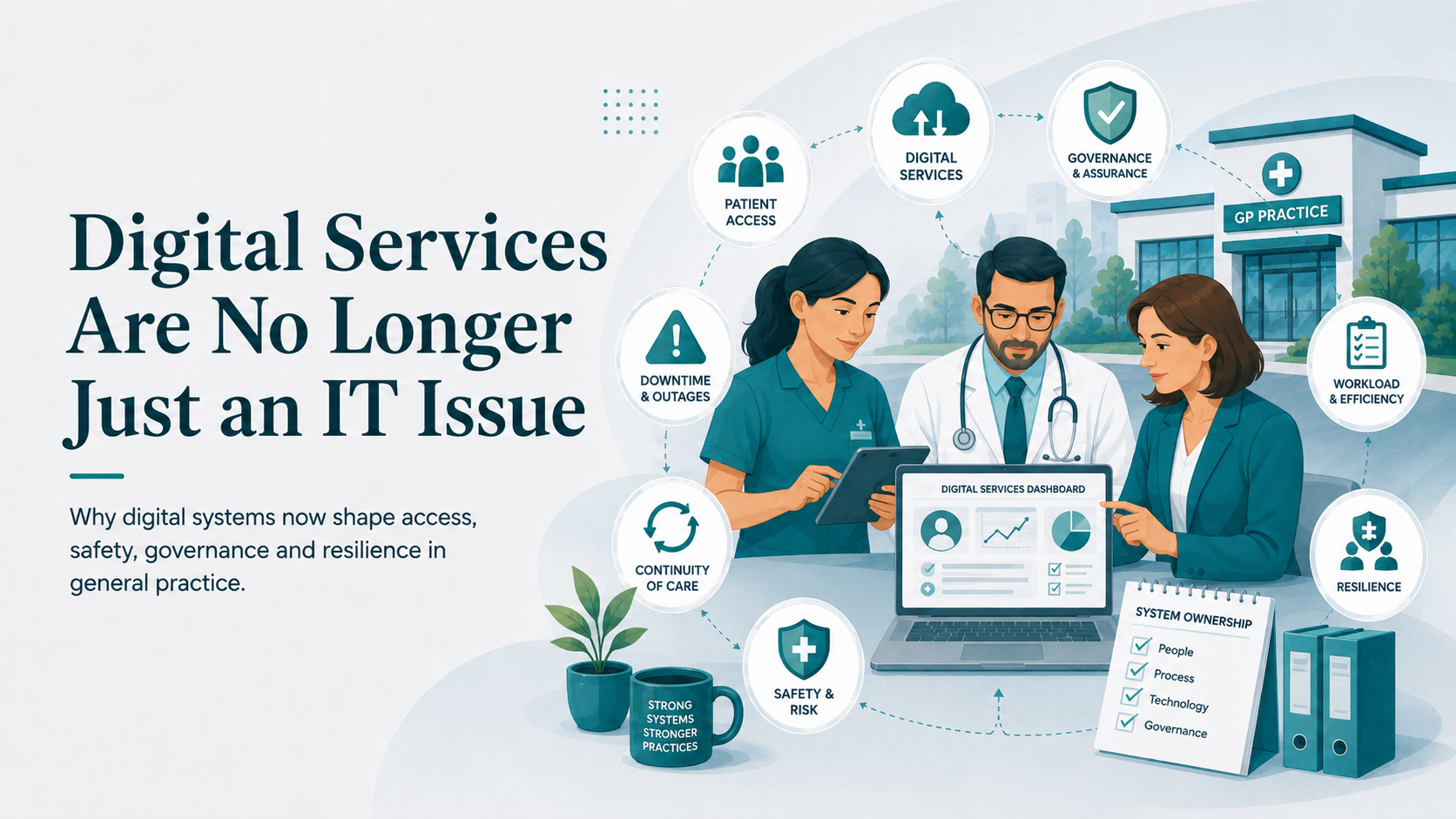
Digital services are no longer just an IT issue. They are part of access, safety, continuity, governance, workload, patient experience and practice resilience.
When digital services work, nobody notices.
Appointments appear in the right place. Consultations flow through the system. Results arrive. Messages are sent. Templates load. Referrals move. Staff log in, patients access services, and the day carries on.
But when digital services fail, the whole practice feels it within minutes.
The phones light up. Reception queues build. Clinicians lose time. Patients become frustrated. Managers start chasing suppliers, ICB contacts, helpdesks, business continuity plans and that one person who “usually knows how this works”.
That is why the updated NHS England ICB Practice Agreement for digital services in general practice matters.
On the surface, it may look like another formal document. Another agreement. Another set of terms between practices and the wider system. But for those of us managing the operational reality of general practice, it is a reminder of something much bigger:
Digital services are not just IT. They are infrastructure.
General practice now runs on digital infrastructure
Modern general practice is almost impossible to imagine without digital systems.
Clinical systems, online consultation platforms, digital telephony, document management, GP Connect, NHS App messaging, e-referrals, electronic prescribing, reporting tools, dashboards, shared records, call recording, remote access, cloud-hosted applications and third-party integrations all form part of the working day.
Some are nationally provided. Some are commissioned by ICBs. Some are chosen locally. Some have been bolted on over time because a problem needed solving quickly.
The result is that many practices now operate with a digital environment that is essential, complex and often not fully mapped.
That creates a risk.
Not because practices are careless, but because general practice has had to adapt at pace. Digital transformation has often happened in layers: one system added for access, another for reporting, another for messaging, another for workflow, another for compliance, another because the previous system did not quite do what was needed.
Before long, the practice is dependent on a web of systems, suppliers, permissions, integrations and processes that nobody has fully stepped back to review.
That is where the small print starts to matter.
This is not just a document for IT leads
The updated ICB Practice Agreement should not be seen as something that only concerns digital leads, IT teams or ICB colleagues.
It matters to practice managers because digital services now sit at the centre of daily operations.
Digital telephony
A failure in digital telephony is an access issue.
Online consultation routing
A problem with routing is a workload issue.
Clinical integrations
A broken integration with the clinical system is a safety issue.
Information governance
A missing DPIA is an information governance issue.
Poorly controlled user access is a security issue. A lack of business continuity planning is a resilience issue. Unclear responsibility between practice, ICB and supplier is a management issue.
In other words, digital governance is operational governance.
The question is no longer simply, “Does the system work?”
The better question is: “Do we understand how this system supports safe care, who owns it, what risks it creates, and what happens if it stops working?”
The hidden risk: systems everyone uses, but nobody owns
One of the biggest risks in practice digital environments is informal ownership.
Every practice has examples.
- A template built years ago by someone who has since left.
- A reporting spreadsheet that only one person understands.
- A shared mailbox rule that quietly redirects key information.
- A third-party tool that was introduced for a project and then became business as usual.
- A clinical protocol embedded into a digital workflow but not reviewed when guidance changed.
- A login account still active because nobody was quite sure whether it was safe to remove.
- A dashboard that looks useful but is built on assumptions nobody has checked recently.
None of these issues usually start as major risks. They start as workarounds, improvements, fixes and practical solutions.
That is very general practice.
The problem comes when those solutions become part of the core operating model without the same level of governance as everything else.
If a digital process affects patient access, clinical workflow, information sharing, coding, prescribing, referrals, reporting or communication, then it needs ownership.
Not bureaucracy for the sake of it. Just enough control to know that the practice is safe, compliant and resilient.
Digital maturity is not about having more systems
There is a temptation to treat digital maturity as a race to adopt more technology.
More platforms. More automation. More dashboards. More online routes. More digital front doors.
But digital maturity is not measured by the number of systems a practice has.
It is measured by how safely and effectively those systems are used.
- What systems do we rely on every day?
- Who is responsible for each one locally?
- What is provided by the ICB and what is practice-owned?
- What supplier support arrangements exist?
- What data flows through each system?
- Are the DPIAs and privacy information current?
- How are staff access rights reviewed?
- What is the downtime process?
- How are changes tested before going live?
- How do we know the system is still doing what we think it is doing?
These are not glamorous questions.
They will not make a shiny transformation slide.
But they are the questions that stop digital transformation becoming digital fragility.
The access agenda makes this even more important
The direction of travel in general practice is clear: more digital access, more online contact, more structured navigation, more interoperability and more use of data to understand demand and performance.
That brings opportunity.
Good digital systems can make access clearer, reduce duplication, improve routing, support continuity, free up admin time and give practices better visibility of workload.
But they can also create pressure if they are poorly implemented.
- A digital route that generates demand without workflow design will increase stress.
- An online consultation system without clear triage rules will create inconsistency.
- A dashboard that is not understood can drive the wrong decision.
- A messaging tool without governance can blur boundaries with patients.
- A system that looks efficient for one team may simply move work somewhere else.
This is why practice managers need to be in the digital conversation early.
Not after the procurement decision. Not after the go-live date. Not when the first complaint arrives.
Practice managers understand the operational consequences. They know how work actually moves through the building. They know which process depends on which person, which inbox, which rota, which session, which supplier and which workaround.
That knowledge is essential if digital change is going to support practice sustainability rather than quietly add another layer of demand.
What practices should do now
The updated agreement is a useful prompt for practices to take stock of their digital environment.
This does not need to become a huge project. A practical review can start with a simple digital services register.
List the systems, tools and platforms the practice relies on. For each one, record:
| Area | What to record |
|---|---|
| Purpose | What the system is used for. |
| Provision | Whether it is ICB-provided, nationally provided, practice-owned or supplier-managed. |
| Ownership | The local owner within the practice. |
| Support | The key supplier, helpdesk or support contact. |
| Data | The type of data processed by the system. |
| Governance | Whether a DPIA or information governance review exists. |
| Access | How staff access is granted, reviewed and removed. |
| Continuity | The downtime or business continuity process. |
| Review | When the system or process was last reviewed. |
That single register can quickly reveal where the risks sit.
It may show that some systems have no clear owner. It may show that user access has not been reviewed for some time. It may show that the practice has a business continuity plan for the clinical system but not for other tools that have become equally important to daily work.
It may show that a process created as a temporary fix is now part of normal service delivery.
That is not failure. That is exactly why the review is useful.
A practical checklist for practice managers
The role of the ICB and the role of the practice
The ICB Practice Agreement helps frame responsibilities between the wider system and practices.
That is important because general practice cannot carry digital risk alone.
Practices need clear support, safe procurement routes, reliable infrastructure, responsive helpdesk arrangements, cyber security support, and clarity about which services are provided and maintained by the ICB.
At the same time, practices need to understand their local responsibilities.
That includes using systems safely, managing staff access, following information governance requirements, reporting incidents, maintaining local processes and making sure digital tools are embedded into safe operational practice.
The best digital environments are not created by either side working in isolation.
The ICB
May provide the infrastructure, support routes and commissioned services.
The supplier
May provide the tool, technical support and product functionality.
The practice
Understands the workflow, the patient journey and the operational reality.
The ICB may provide the infrastructure, but the practice understands the workflow. The supplier may provide the tool, but the practice understands the patient journey. The national model may set the direction, but the local team understands the operational reality.
Final thought
The updated digital services agreement is easy to file away as another formal NHS document.
But it should be treated as a useful prompt.
General practice is now deeply digital. That brings enormous opportunity, but also a new type of operational risk.
The practices that manage this well will not necessarily be the ones with the most systems. They will be the ones that understand their systems, own their processes, review their risks and plan for failure before it happens.
Digital maturity is not about having more technology. It is about knowing which technology matters, who owns it, what risk it carries, and what happens when it stops working.
That is not just IT.
That is modern practice management.